
I am a dad of three boys, aged 7, 5, and 3, in Dallas. For a long time, our week lived in my head. I knew who needed to be where, what was for dinner, and which form was due—until I didn't. A date would land in a school email, a text, or a flyer, and if I missed it, nobody else had a place to look.
The house ran on my memory, and memory is a bad system for a house with three kids.
This is the habit that got us off that. It takes about ten minutes on Sunday, and it does not require a new personality. It requires one shared plan, a named owner for each job, and the same four questions every week.
Helping is not the same as owning
If you are a dad who "helps a lot," this part may sting, because it stung me.
When you help, someone else is still the manager. They notice what needs doing, decide how it should be done, and then hand you a piece of it. When you own a job, you do all three parts: you notice, you plan, and you do.
That is why splitting a list of chores down the middle can still leave one parent exhausted. The tasks got shared. The thinking did not.
The fix is not "I will do more." The fix is to take one whole job, from start to finish.
Own one whole job, not a pile of small ones
In our house, I took two jobs that come up every week: the calendar and dinners. Not "I will help put dates on the calendar." Not "I will cook when I am asked." Own them.
- Owning the calendar: I read the school emails and activity schedules, put every date in one place, and look for conflicts before they become a scramble.
- Owning dinners: I decide what we will eat, make sure the groceries are there, and plan the nights when cooking is hard. In our house, those dinners live on a meal grid, not on the calendar. The calendar is for where people need to be. The meal grid is for what we eat.
If you are starting this week, pick one of those two. Choose a job with a clear beginning and end that comes around every week. "Keeping the house tidy" is a poor first job, because nobody can tell when it is done.
One plan that everybody can trust
A shared plan only works if everybody believes it. So we agreed on a few simple rules with my partner:
- Anything that involves the kids or a car goes on the shared calendar the same day we hear about it.
- If you change something, you change it there, not in a text.
- When someone wants to know if Saturday is free, they can look instead of asking.
The same idea applies to dinners. The meal grid is the plan. If Thursday is going to be a hard night, the easy dinner is already written there on purpose—not hoped for when everyone is already hungry.
The Sunday reset, in four questions
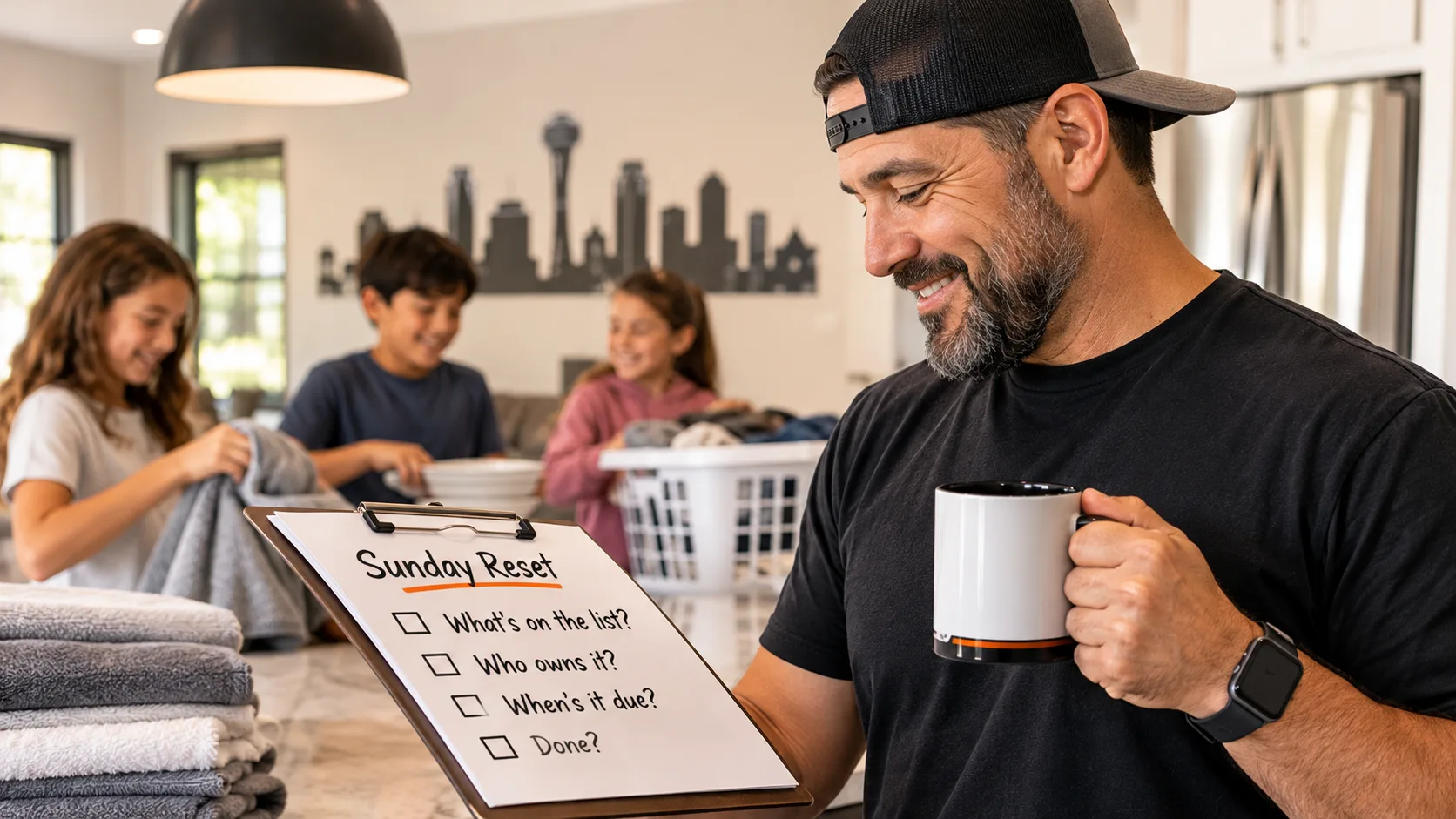
Once those jobs had an owner, I still needed a way to stay ahead of them without thinking about the week all week. That is the Sunday reset. I do it Sunday evening after the boys are in bed, and I run through the same four questions every time:
- What is different about this week? Early pickups, half days, a dentist visit, a work trip. The point is to catch the exceptions before Monday.
- Who is driving where? Every practice, party, and appointment gets a name next to it. "Someone will handle it" is how two parents show up at the same place, or nobody does.
- Which nights are hard? Those get the easiest dinners, or leftovers, planned on purpose. A late activity and a meal that needs a long stretch in the kitchen do not belong on the same night.
- What do the kids need to bring? Library books, a field trip form, a snack for the team. The 7-year-old can pack a bag if he knows what goes in it. The 3-year-old cannot. Either way, that list should not live in one person's head until the car is already running.
Then I share the answers in a couple of minutes. My partner does not have to hold any of it, but they can see the shape of the week. The point is not a perfect plan. The point is that the week is written down, in one place, before it starts.
Name an owner for each recurring chore
The calendar and dinners were the first jobs. Recurring chores need the same treatment, or they bounce back to the default parent: the person who notices first.
For each recurring chore, put a name next to it—not "the kitchen," not "whoever is free," a person. Trash, lunch boxes, laundry, the weekly grocery run: each one gets an owner. The owner notices when it is due, plans for it, and does it, or asks for help on purpose.
Kids can own some of this too, in an age-right way:
- 7-year-old: Brings the lunch box to the kitchen after school.
- 5-year-old: Puts dirty clothes in the hamper.
- 3-year-old: Can help, but should not own a job the house depends on. The adult still owns the jobs that have to happen even when a kid forgets.
When a job has a name on it, you stop renegotiating it every Tuesday. If it is not getting done, you talk about that job, not about who "never helps."
Let the new owner do it their way
This last part is for the parent handing a job over, because it is the part that quietly fails.
When a job moves, the first few weeks will not look the way the old owner would have done it. If they keep checking and correcting, the job moves back to them. The new owner learns that they are still just helping.
Agree on what really matters—like "the kids eat something real most nights" or "the calendar is complete by Sunday night"—and let the rest be theirs. You will get some of your head back, and that is the whole point.
If you want to try this week
- Choose one whole job that comes up every week (the calendar or dinners) and agree on who owns it from noticing to doing.
- Separate your tools: Put every family date in one shared calendar, and keep dinners on a meal grid, not mixed into the calendar.
- Assign names: Put a person's name next to each recurring chore.
- Run a 10-minute Sunday reset using the same four questions: what is different, who is driving where, which nights are hard, and what the kids need to bring.
None of this needs a big talk or a new set of tools. It needs one clear handoff, a short weekly habit, and the patience to let it settle.